Cabin Smoke Prompts SWISS A330 Emergency Landing in Maine
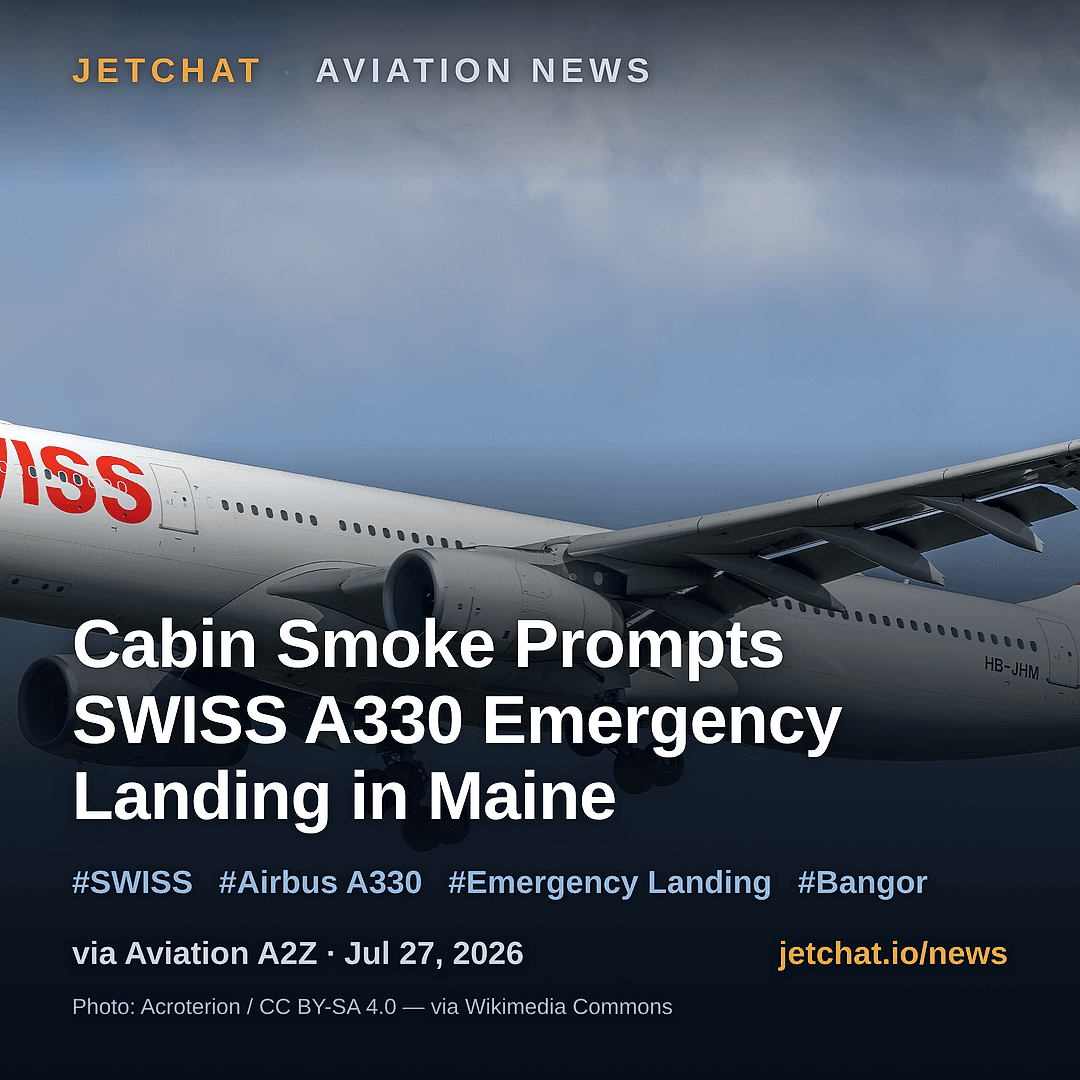
Photo: Acroterion / CC BY-SA 4.0 — via Wikimedia Commons (CC BY-SA 4.0) · source
A SWISS Airbus A330 en route from Zurich to New York diverted to Bangor International Airport after crew members detected smoke in the business class cabin. Cruising at 32,000 feet near Nova Scotia, the pilots declared an emergency and initiated a rapid descent, landing safely in Maine where ground crews found no active fire. For flight crews, cabin smoke of unknown origin dictates an immediate diversion, underscoring the critical importance of swift aeronautical decision-making and utilizing established diversion fields along North Atlantic Tracks.
Read the full take
The diversion of SWISS Flight LX16 highlights textbook execution of emergency procedures regarding in-flight smoke, fire, or fumes. When the crew detected smoke of unknown origin in the forward cabin, they immediately declared an emergency and descended rapidly, dropping 22,000 feet in roughly ten minutes to target Bangor International Airport. Bangor serves as a vital diversion point for transatlantic traffic due to its expansive runway and strategic geographic placement near the North American coastline. For pilots, smoke and fume events are exceptionally time-critical. Without knowing the exact source, crews must assume a hidden fire could quickly compromise the airframe. The rapid descent and immediate diversion reflect standard operating procedures designed to get the aircraft on the ground before a potential fire can spread or toxic fumes incapacitate passengers. Interestingly, this specific 14-year-old A330 experienced a severe high-speed rejected takeoff in Delhi just three months prior, which resulted in a slide evacuation and several injuries following an engine failure. While the two incidents are almost certainly unrelated, maintenance teams will rigorously scrutinize the aircraft's systems to isolate the source of the recent smoke. Aviation professionals will watch the resulting investigation closely to see if the fumes originated from an air conditioning pack, an electrical fault in the galleys, or a passenger's lithium-ion device, which is an increasingly common culprit in modern cabin smoke events.