Fatal Mid-Air Collision Claims Two Firefighting Helicopter Crew in Greece
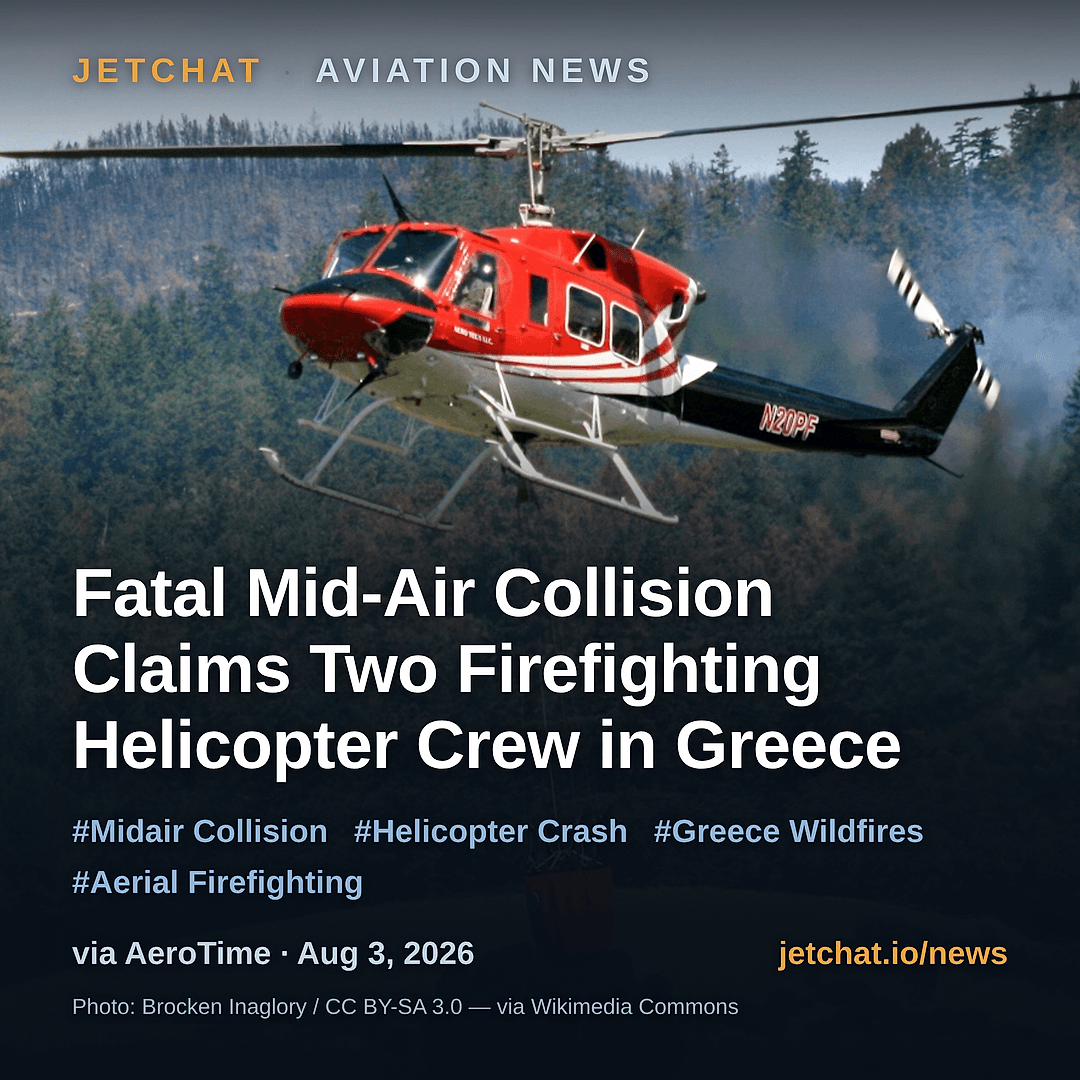
Photo: Brocken Inaglory / CC BY-SA 3.0 — via Wikimedia Commons (CC BY-SA 3.0) · source
Two crew members died and two others were injured when a pair of Bell firefighting helicopters collided mid-air in Greece on August 3. The aircraft, operated by Australian firm McDermott Aviation, were battling intense wildfires west of Athens when one helicopter's main rotor impacted the belly of the other. The struck aircraft crashed and burned, while the second managed an emergency landing. This tragic accident underscores the extreme spatial awareness and communication hazards aerial firefighting crews face when operating in dense smoke and high-traffic fire areas.
Read the full take
Aerial firefighting remains one of the most hazardous sectors in civilian aviation, demanding precise coordination in an inherently chaotic environment. When multiple aircraft operate in a confined Fire Traffic Area, pilots are forced to manage an overwhelming flow of sensory input. They must dodge terrain, navigate severe updrafts caused by the fire's heat, and coordinate drops with other aircraft, all while visibility is severely degraded by dense smoke. The August 3 collision west of Athens is a stark reminder of how quickly these risk factors can compound. Investigators will likely focus heavily on the airspace de-confliction procedures in place during the incident. Operating alongside international contractors adds a layer of complexity to communication and standard operating procedures. When crews from different nations and agencies converge over a single blaze, standardized radio calls and strict altitude separations are the only things keeping them apart. In the immediate aftermath, Greek authorities grounded all Bell helicopters contracted for fire suppression in the country. While a standard precautionary measure, it places additional strain on a region currently battling a severe wildfire season. Moving forward, the aviation community will be watching the accident report for insights into whether the collision stemmed from a breakdown in radio communication, a visual blind spot, or sudden wind shear pushing the aircraft together. For pilots aspiring to enter the aerial firefighting industry, this tragedy highlights the unforgiving nature of the job and the absolute necessity of rigorous Crew Resource Management.