Kalitta Boeing 777 Suffers Tail Strike During Cincinnati Go-Around
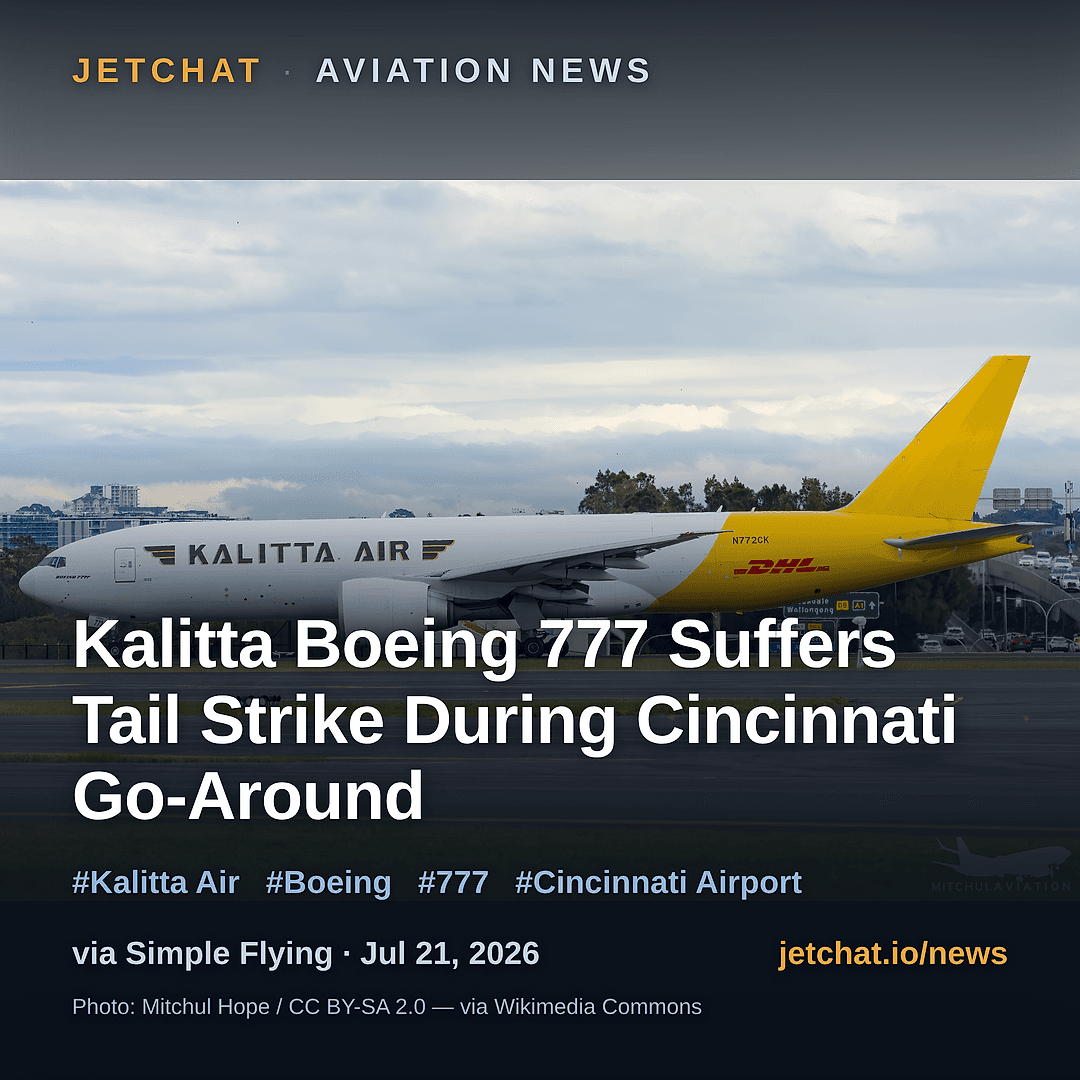
Photo: Mitchul Hope / CC BY-SA 2.0 — via Wikimedia Commons (CC BY-SA 2.0) · source
A Kalitta Air Boeing 777-300 freighter scraped its tail on the runway during a go-around attempt at Cincinnati Northern Kentucky International Airport. Operating as Flight 264, the heavy cargo jet aborted its initial landing, causing the lower aft fuselage to strike the pavement and generate visible sparks before climbing away. The flight crew subsequently maneuvered the aircraft for a successful and safe landing on their second approach. This incident serves as a stark reminder for pilots about pitch control and energy management during a late-stage balked landing.
Read the full take
The recent tail strike involving a Kalitta Air Boeing 777-300 at Cincinnati Northern Kentucky International Airport highlights the inherent risks of executing a go-around near the runway surface. For student pilots and seasoned airline crews alike, the balked landing is a high-workload maneuver that demands immediate transition from a descending, decelerating state to a climbing, accelerating one. In long-body aircraft like the 777-300, the margin for error in pitch attitude is notably unforgiving. When applying maximum thrust to abort a landing, the aircraft naturally wants to pitch up. If the flight crew does not actively manage this rotation rate, the extended aft section can easily contact the tarmac. Modern widebody jets are equipped with tail skid mechanisms designed to absorb some impact and protect the pressure bulkhead, but significant structural damage can still occur. Aviation authorities will likely review the flight data recorder and cockpit voice recorder to determine what precipitated the go-around and how the pitch limits were exceeded. Investigators will examine environmental factors such as low-level windshear, mechanical anomalies, and crew resource management. For the aviation community, this event reinforces the importance of flying the airplane through the entire go-around sequence, prioritizing a positive rate of climb over an aggressive pitch attitude, and maintaining strict situational awareness when operating heavy, extended-fuselage aircraft close to the ground.