Traveled Work Continues to Hamper Boeing 737 Wichita Production
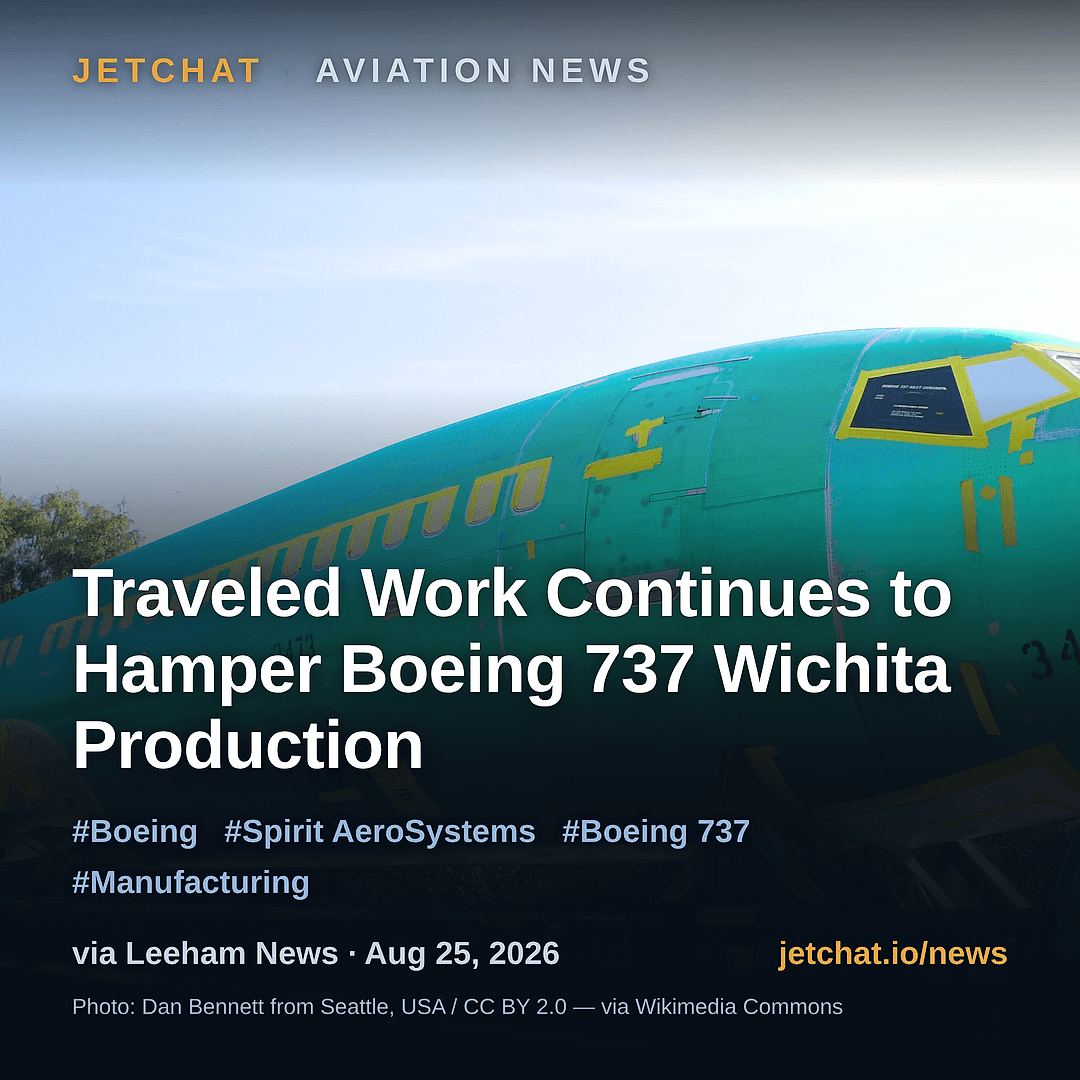
Photo: Dan Bennett from Seattle, USA / CC BY 2.0 — via Wikimedia Commons (CC BY 2.0) · source
Out-of-sequence manufacturing, commonly known as traveled work, continues to present significant hurdles at the former Spirit AeroSystems facility in Wichita, Kansas. Boeing recently reacquired the plant to tighten quality control and stabilize the 737 assembly line, but workers report that out-of-order tasks remain a stubborn issue. Eliminating these manufacturing bottlenecks is essential for Boeing to safely increase its narrowbody production rates. For commercial pilots waiting on fleet expansions, these factory delays translate directly into slower delivery schedules and prolonged capacity constraints at major airlines.
Read the full take
The persistence of traveled work at the Wichita fuselage plant underscores the massive logistical challenge Boeing faces in reabsorbing Spirit AeroSystems. Traveled work occurs when a specific assembly task is delayed, often due to missing parts or engineering hold-ups, forcing workers to complete the job further down the production line than originally planned. This practice inherently increases the risk of defects, as technicians must perform intricate installations in cramped or fully assembled sections of the airframe, bypassing the specialized tooling and rigorous quality gates designed for earlier stages. Boeing's strategic acquisition of its former supplier was primarily aimed at eliminating these exact inefficiencies. By bringing the Wichita facility back in-house, the aerospace giant hoped to implement stricter quality management systems and establish a more linear, predictable manufacturing flow for the 737 program. However, untangling years of fragmented supply chain practices takes time. Factory floor workers note that while management is prioritizing proper sequence, the reality of part shortages and legacy processes continues to force out-of-order assembly. For the broader aviation community, from aspiring first officers to veteran captains, these manufacturing woes have tangible career impacts. The 737 is the backbone of short-haul operations for numerous global carriers. Whenever production rates stumble or quality inspections require extensive rework, airlines are forced to trim their schedules, freeze hiring, or delay upgrade training. Industry observers should watch Boeing's delivery figures closely over the next few quarters. The true measure of success for the Spirit reintegration will not be corporate restructuring, but a verifiable reduction in traveled work and a steady, defect-free flow of new jets to the flight line.