UK Court Clears Gatwick Airport to Build Second Runway
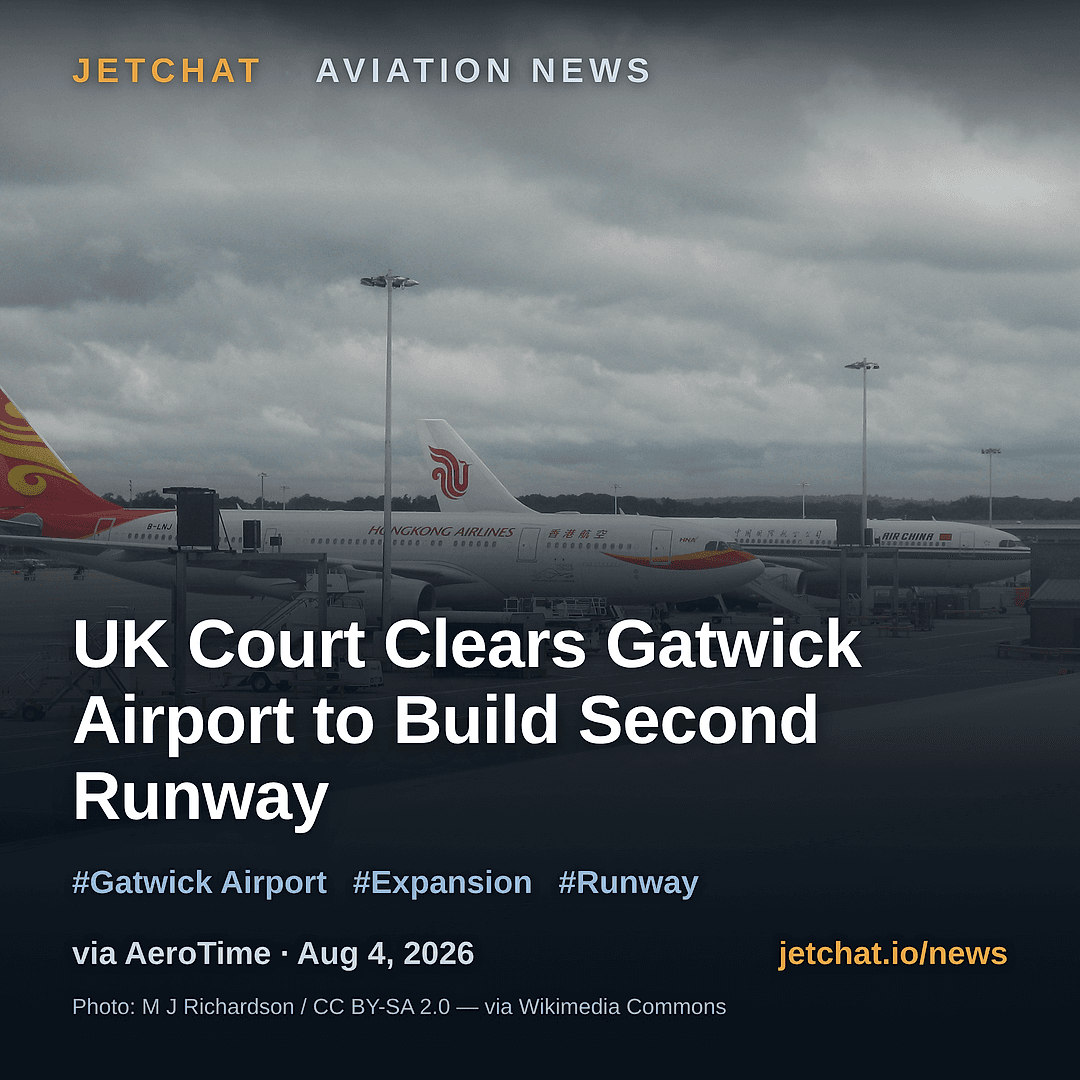
Photo: M J Richardson / CC BY-SA 2.0 — via Wikimedia Commons (CC BY-SA 2.0) · source
London Gatwick Airport has secured final legal clearance to develop a second active runway after the UK Court of Appeal dismissed challenges from local opposition groups. The multibillion-dollar project will reposition the airport's existing standby surface by twelve meters to facilitate simultaneous dual operations. Slated to accommodate a hundred thousand additional annual aircraft movements, this massive infrastructure expansion offers aspiring airline pilots a significant long-term boost in career opportunities across European and transatlantic routes.
Read the full take
For years, the physical limitations of London airspace have presented major operational headaches for flight crews and airline planners alike. Gatwick's reliance on a single primary runway has historically capped its growth, forcing companies to maximize efficiency at the expense of flexibility during irregular operations. This latest court victory, which ends an exhaustive eight-year planning and legal battle, grants the facility clearance to reposition its standby tarmac by twelve meters. Once completed, the airport will transition into a true dual-runway environment. For the aviation workforce, the scale of this project translates directly to long-term career prospects. Adding capacity for an estimated 13 million extra travelers and a hundred thousand annual aircraft movements requires a massive ramp-up in personnel. Regional and international carriers operating out of the hub will need to expand their pilot bases to support the resulting schedule density. Student pilots and instructors building hours today will likely see these flight deck vacancies materializing just as they reach competitive hiring minimums. While airport executives and government officials celebrate the projected economic infusion, environmental and community noise organizations remain firmly opposed. Having exhausted their primary legal avenues to block the physical tarmac expansion, these groups are pivoting their focus toward forthcoming airspace redesigns and terminal construction plans. Pilots flying in and out of the London Terminal Control Area should anticipate future regulatory scrutiny regarding approach procedures, noise abatement profiles, and emissions standards as the local community attempts to mitigate the footprint of dual-runway operations.