UK regulator flags concerning rise in continued unstable approaches
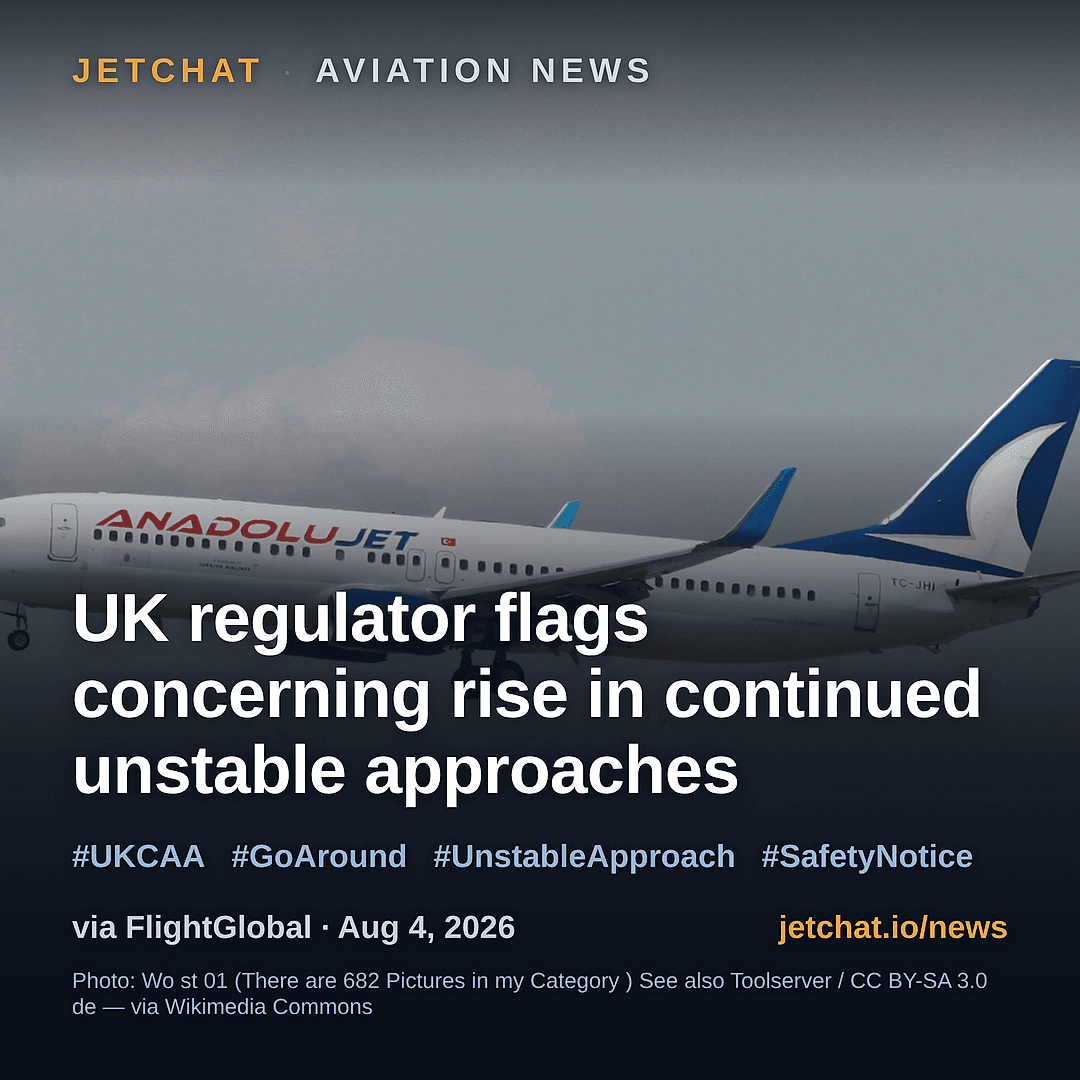
Photo: Wo st 01 (There are 682 Pictures in my Category ) See also Toolserver / CC BY-SA 3.0 de — via Wikimedia Commons (CC BY-SA 3.0 de) · source
The United Kingdom Civil Aviation Authority recently issued a safety bulletin highlighting a concerning increase in flight crews failing to execute go-arounds during unstable approaches. Agency data reveals that pressing on with a flawed setup increases the likelihood of a tail-strike or heavy touchdown by up to one hundred times. Regulators warn that successfully landing after a poor approach breeds dangerous complacency. This serves as a vital reminder for all aviators that initiating a missed approach is always preferable to forcing a bad landing.
Read the full take
The core issue the aviation authority is tackling is the psychological trap known as the normalization of deviance. When pilots force an aircraft onto the runway despite carrying excessive speed, having an improper configuration, or experiencing poor glideslope alignment, they often manage to stop safely. That lack of an immediate negative consequence tricks the human brain into assuming the reduced safety margin was perfectly adequate. Over time, flight crews might start viewing the missed approach as a drastic emergency maneuver rather than a standard, expected response to a degrading flight path. The regulatory data paints a stark picture of the actual mathematical risk involved in this mindset. Choosing to land a misaligned airplane multiplies the chance of bending metal by two orders of magnitude, frequently manifesting as deep touchdowns, violently firm arrivals, or rear fuselage runway contact. For those currently building flight hours or learning the ropes in light training aircraft, this lesson scales perfectly from a primary trainer up to a widebody airliner. Flight instructors drill the concept of stabilized approach criteria from day one for a very good reason. Pilots must never let external factors like passenger expectations, company timetables, or personal pride discourage them from applying takeoff power and climbing away. A go-around is never a failure of airmanship; it is a proactive defensive action. Authorities emphasize that the only valid reason to salvage a bad approach is if flying the missed procedure introduces a demonstrably higher danger. Otherwise, aviators must maintain proficiency and confidence in their go-around procedures so that the decision to wave off becomes a stress-free reflex.