FAA investigates Marine One separation loss near Reagan National
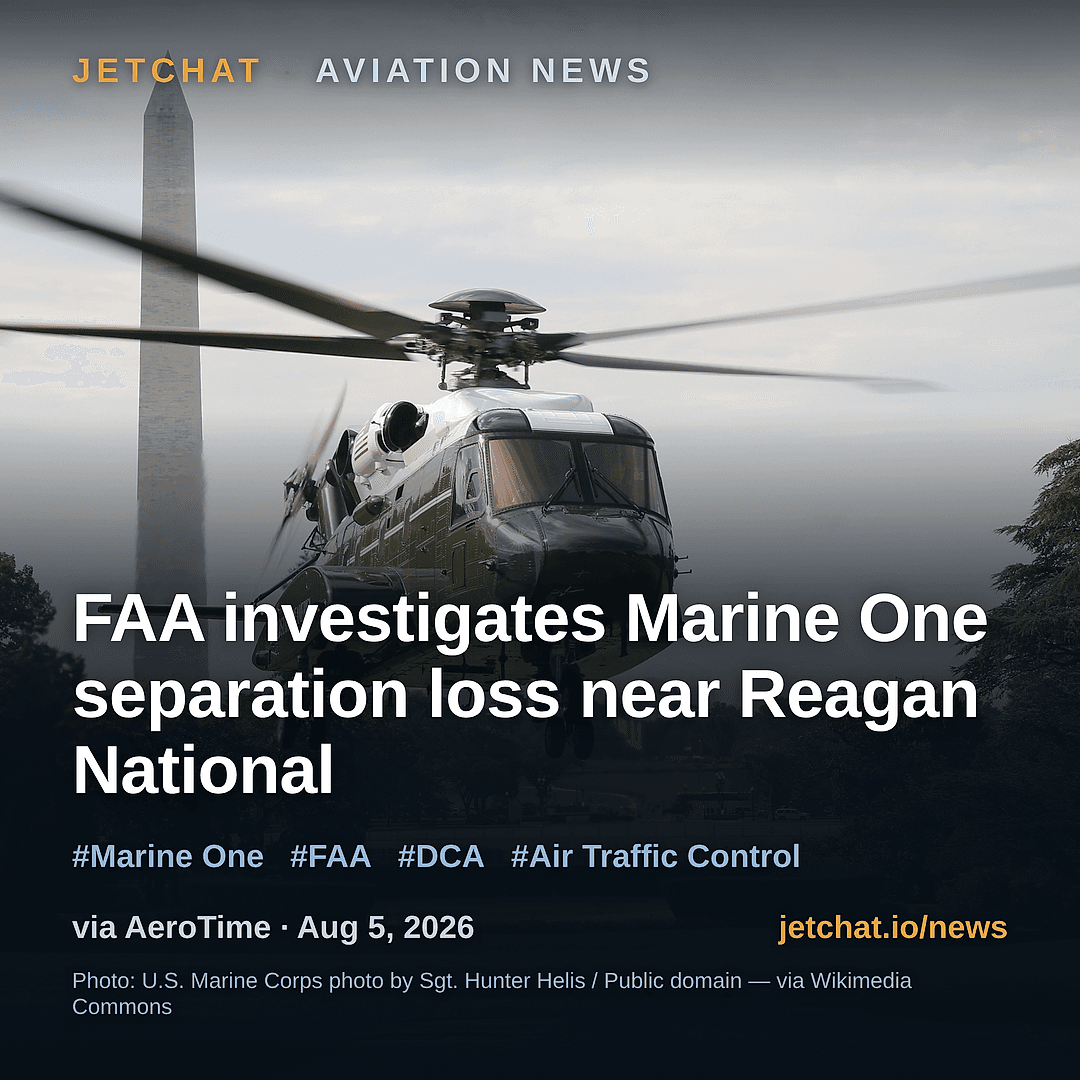
Photo: U.S. Marine Corps photo by Sgt. Hunter Helis / Public domain — via Wikimedia Commons (Public domain) · source
The FAA is looking into an August 2026 airspace incident where Marine One and an Envoy Air Embraer E175 flew too close together near Ronald Reagan Washington National Airport. The presidential helicopter and the regional jet breached the standard Class B separation limits of 1.5 nautical miles or 500 feet, though officials note the aircraft were not on converging flight paths. This highlights why strict adherence to instrument separation protocols remains a crucial focus for pilots and controllers navigating congested metropolitan corridors.
Read the full take
Operating in the heavily restricted airspace around Washington, D.C. requires intense precision from both pilots and air traffic controllers. Ronald Reagan Washington National Airport sits in a tightly woven Class B sector, complicated by strict no-fly zones and frequent VIP movements. The recent separation loss between Marine One and an Envoy Air Embraer E175 underscores the fragility of this high-stress environment, even when aircraft are under positive control. While early reports indicate the helicopter and the regional jet were not actively converging, they still breached the strict Class B separation minimums of 500 feet vertically or 1.5 nautical miles laterally. This incident is particularly notable because it tests the robustness of new protocols implemented following a devastating midair collision in early 2025. That previous tragedy over the Potomac River prompted the FAA to restrict the use of visual separation tactics in the area, forcing controllers to rely on hard instrument separation criteria. For professional flight crews and aspiring aviators, this event is a stark reminder of how quickly spacing can deteriorate during VIP operations. When presidential aircraft maneuver through tight metropolitan corridors, standard commercial flow often has to be paused or aggressively rerouted. A breakdown in those holds can instantly trigger a separation loss. As the FAA investigates why controllers failed to hold the Envoy flight, pilots flying into any complex Class B airspace should remember to maintain maximum situational awareness, utilize all available traffic advisory systems, and never assume that air traffic control's workload guarantees flawless spacing during irregular operations.