FAA Proposes Dropping Third-Class Medicals for Military Pilot Trainees
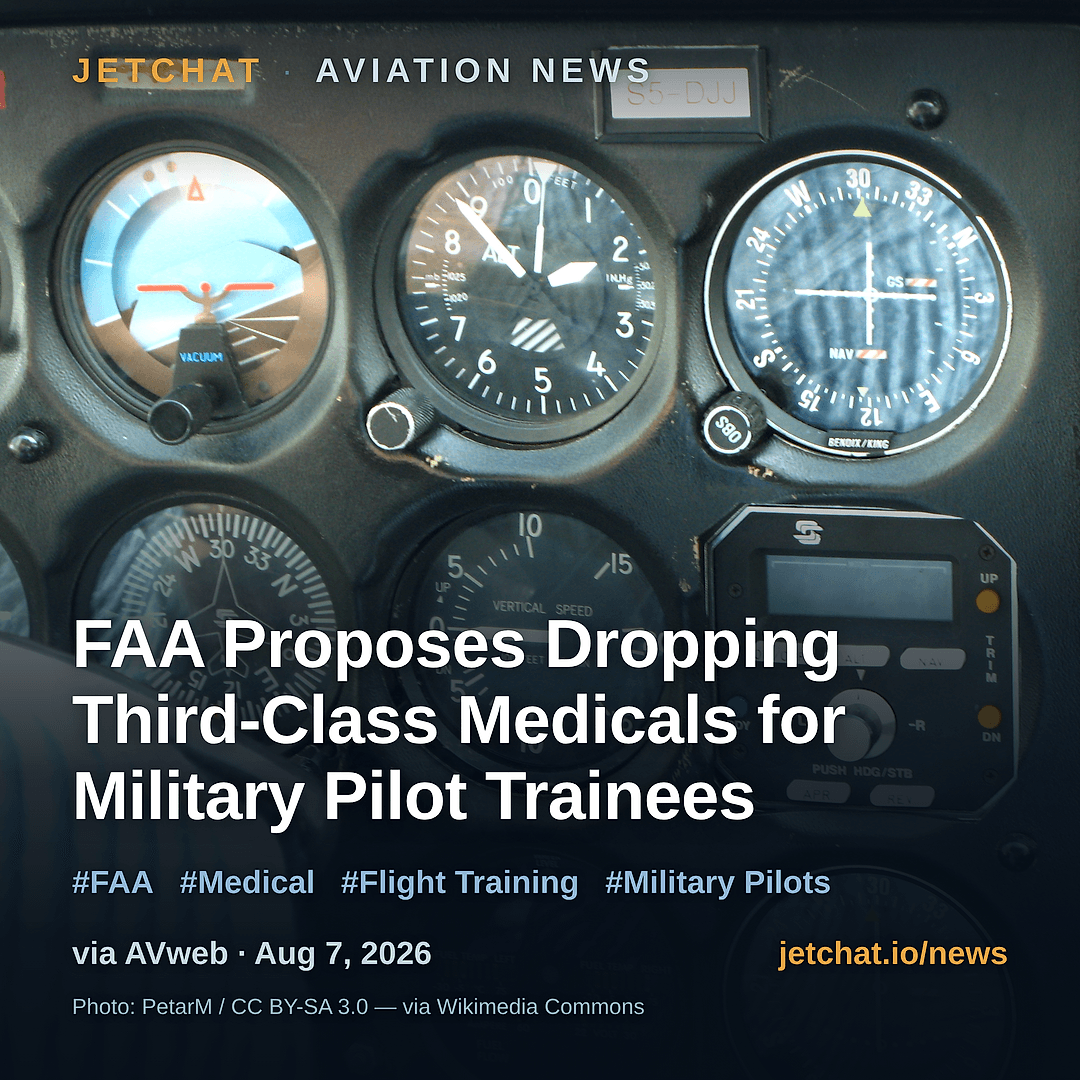
Photo: PetarM / CC BY-SA 3.0 — via Wikimedia Commons (CC BY-SA 3.0) · source
The Federal Aviation Administration is looking to eliminate the third-class medical certificate requirement for military flight trainees who already possess a valid armed forces medical examination. While fully qualified military aviators have enjoyed this privilege for over a decade, trainees previously needed civilian medicals for solo flights and practical tests in civil aircraft. Expanding this policy beyond existing Air Force exemptions to encompass all service branches will reduce redundancy, saving time and money for instructors and students bridging the gap between civilian and military training environments.
Read the full take
The Federal Aviation Administration's latest proposal marks a logical step in harmonizing civilian and military aviation standards. Since 2009, credentialed military pilots have been able to substitute their armed forces medical clearances for civilian third-class certificates during specific flight operations. However, student pilots in the military pipeline often found themselves caught in a regulatory blind spot. Before executing a solo flight or sitting for a practical test in a civilian aircraft, these trainees were forced to secure a redundant FAA medical certificate. Currently, the agency issues special exemptions for Air Force students attending Part 141 flight schools. By officially embedding this relief into Part 61 regulations, the agency will establish a uniform standard across the Navy, Marine Corps, Army, and Coast Guard, as well as allied foreign trainees sponsored by the United States. Regulators recognize that armed forces medical screenings are exceptionally rigorous, easily meeting and often exceeding the baseline requirements for a civilian third-class medical. Beyond the practical convenience for students and their civilian flight instructors, the administrative impact is notable. The agency calculates that bypassing this duplicate paperwork will cover around two thousand students already operating under special exemptions, while welcoming nearly five hundred additional trainees into the fold each year. For the broader aviation community, this translates to nearly a million dollars in annual savings and less congestion in the queues of Aviation Medical Examiners. It is a welcome efficiency upgrade for civilian schools contracted to build foundational flight hours for the next generation of military aviators.