NTSB Presses Congress for Final Vote on Aviation Safety Legislation
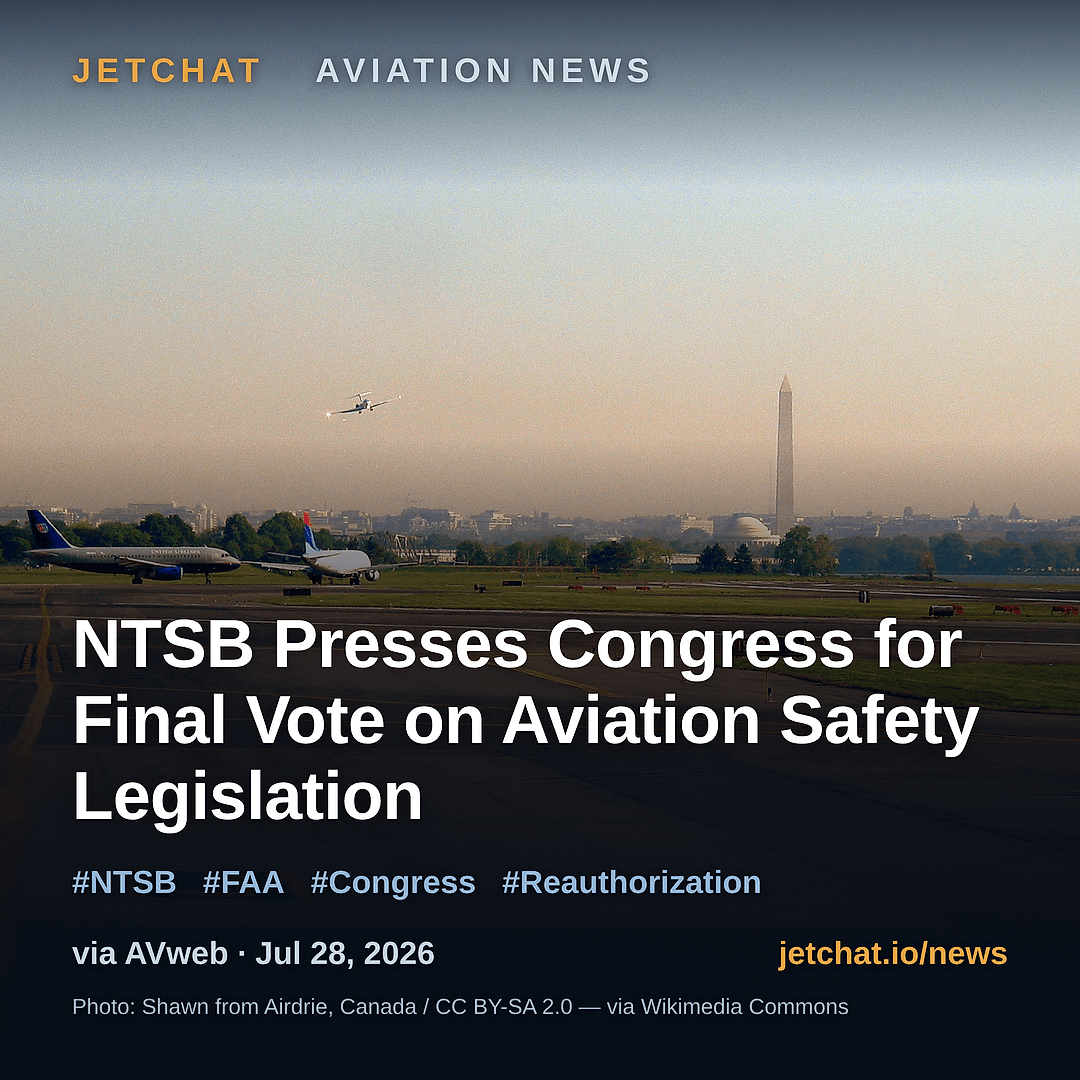
Photo: Shawn from Airdrie, Canada / CC BY-SA 2.0 — via Wikimedia Commons (CC BY-SA 2.0) · source
The National Transportation Safety Board is urging lawmakers to finalize safety legislation following the fatal January 2025 midair collision near Ronald Reagan Washington National Airport. The House and Senate previously passed independent bills addressing the tragedy, but Congress adjourned for its August recess without merging the measures into a unified law. Investigators want immediate action in September to enact all fifty safety recommendations, including a proposed mandate for ADS-B In equipment. For pilots, mandated cockpit traffic displays could soon become a requirement in tightly controlled airspace.
Read the full take
The push for comprehensive legislative action stems from the devastating January 29 collision between a PSA Airlines CRJ700 and a United States Army Black Hawk helicopter, an accident that claimed sixty-seven lives. Following extensive investigations, the safety board identified deep-rooted flaws in airspace architecture, military and civilian oversight, and air traffic control communication. However, the most immediate technological takeaway for the aviation community centers on situational awareness equipment. Investigators determined that an active ADS-B In system could have provided the airline crew with nearly a full minute of warning before the convergence. As a result, one of the board's primary recommendations is a sweeping requirement for both civilian and military aircraft to carry compatible traffic displays and audible alert systems whenever operating in areas currently governed by ADS-B Out rules. While the Senate unanimously passed its reform package late last year, the House advanced a competing measure this spring. The safety board previously criticized the House version for failing to fully embrace the ADS-B In mandate. Now, with lawmakers returning in September, the pressure is mounting to reconcile the differences and deliver a final bill to the president. For flight schools, corporate operators, and private owners, the outcome of this legislative battle is highly significant. An expanded mandate would require financial investments in panel upgrades for older airframes that only comply with current broadcast rules. As the airspace around major metropolitan hubs becomes increasingly complex and densely populated by diverse traffic, pilots should closely monitor these developments, as enhanced electronic visibility standards appear inevitable.