Senators Urge FAA to Release Remaining Controller Pay Raises
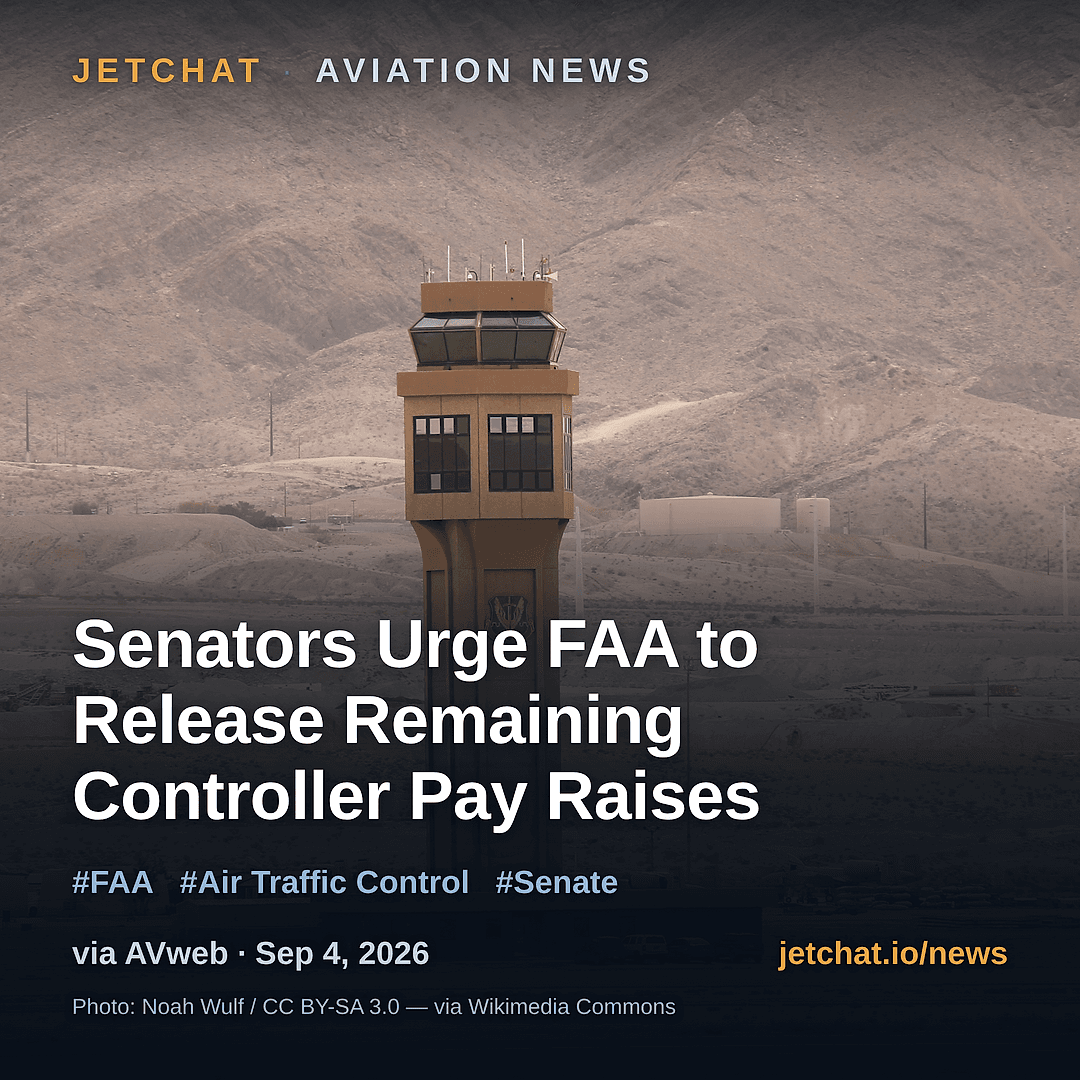
Photo: Noah Wulf / CC BY-SA 3.0 — via Wikimedia Commons (CC BY-SA 3.0) · source
Two U.S. senators are pushing the Federal Aviation Administration to unlock a congressionally approved pay increase for air traffic controllers. While lawmakers authorized a nearly four percent raise earlier this year, agency leadership has withheld the bulk of the funds, citing a mandate to first achieve operational and scheduling efficiencies. Lawmakers argue that demanding higher productivity from an already exhausted workforce compromises safety. For pilots, resolving this labor dispute is critical, as chronic controller fatigue and staffing shortages directly impact route availability, delays, and airspace safety.
Read the full take
The ongoing friction over controller compensation highlights a fundamental standoff between agency leadership and lawmakers regarding how to solve systemic airspace staffing issues. Earlier this year, Congress allocated funds to boost controller pay by nearly four percent, but the Federal Aviation Administration has only distributed a fraction of that amount. The remaining funds are legally tied to the agency administrator certifying that workforce scheduling and operational efficiencies have improved. Agency reports suggest controllers currently spend about half of their eight-hour shifts actively managing traffic, and leadership wants to implement modern scheduling tools to increase that time on position. However, lawmakers and union representatives argue that looking for productivity gains from a workforce already crippled by mandatory overtime is the wrong approach. Controllers have faced relentless schedules over recent fiscal years, leading to documented spikes in fatigue and burnout. For the pilot community, this administrative bottleneck represents a significant threat to daily operations. When air traffic control facilities are understaffed or staffed by exhausted personnel, the entire National Airspace System suffers through flow control programs, ground stops, and reduced sector capacities. Student pilots face delays picking up clearances, while airline crews battle reroutes that disrupt duty limits. The agency aims to collaborate with the controllers union to find a compromise on scheduling practices that might unlock the remaining pay before the end of the year. Until a resolution is reached, the aviation industry will continue watching closely, as the balance between controller well-being and operational efficiency remains vital for safe skies.