FAA Unveils Newark Radar, Seeks $10B for AI ATC System
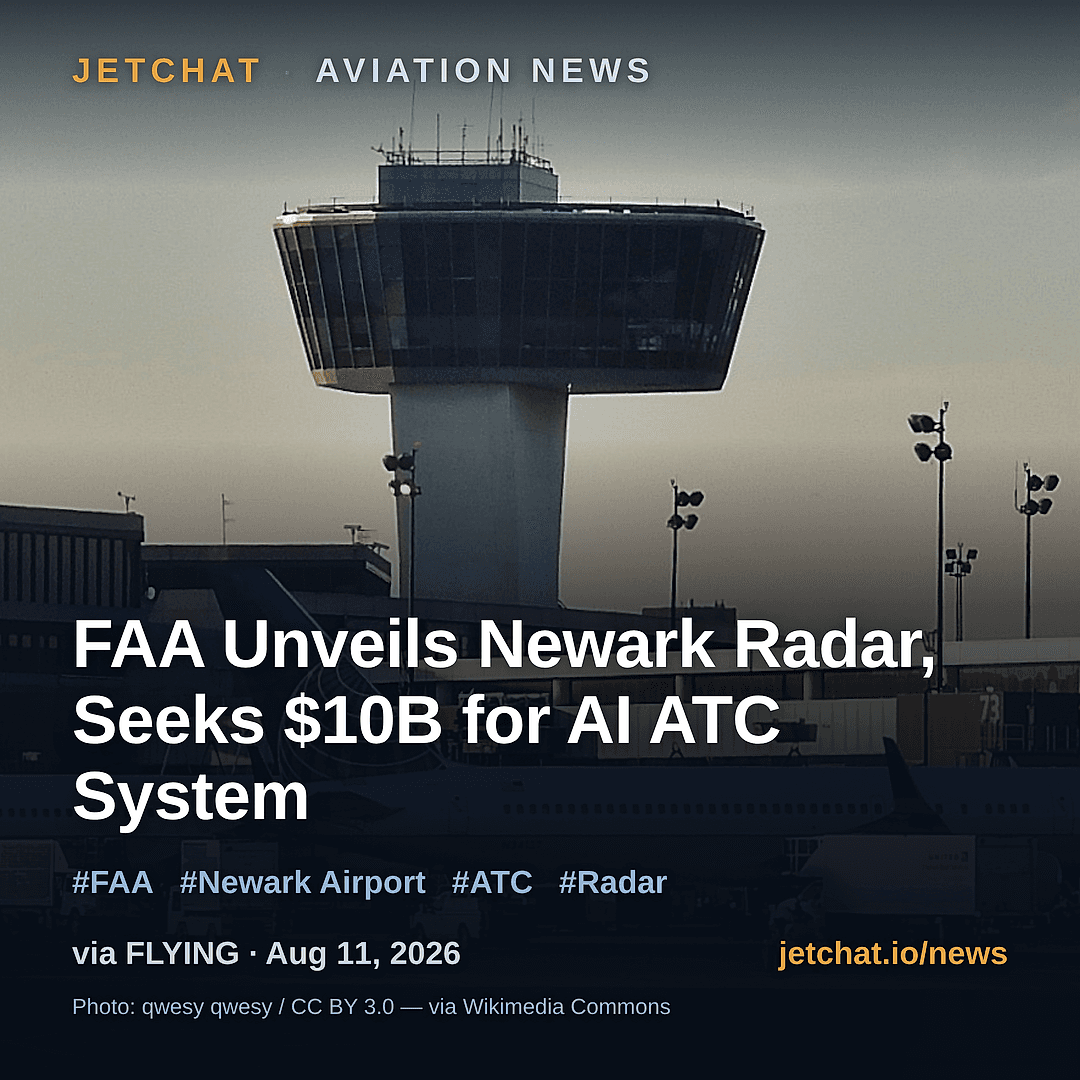
Photo: qwesy qwesy / CC BY 3.0 — via Wikimedia Commons (CC BY 3.0) · source
Transportation and FAA officials inaugurated a modern surface movement radar at Newark Liberty International Airport, replacing obsolete 30-year-old equipment. The deployment coincides with urgent requests from the Department of Transportation for an additional $10 billion to fund further air traffic control modernization, including a new artificial intelligence-assisted airspace management tool. For pilots, these infrastructure and software upgrades mean increased situational awareness on congested ramps and potentially fewer weather-related routing delays as the national airspace system handles growing traffic volumes.
Read the full take
The deployment of Newark's new surface movement radar marks a critical milestone in replacing aging infrastructure across the National Airspace System, but it highlights a massive financial shortfall. Following severe communication outages at the major New Jersey hub last year, Congress allocated an initial $12.5 billion for air traffic control upgrades. However, federal transportation leaders are now signaling that this is merely a down payment. They are actively lobbying for an additional $10 billion to develop an artificial intelligence-driven software designed to predict airspace conditions and streamline routing well in advance. For flight crews navigating the country's most congested corridors, the physical hardware upgrades are providing immediate relief. New surface radar gives controllers precise visibility over taxiways and ramps, mitigating the risk of incursions during low-visibility operations. The FAA is also accelerating the transition from legacy copper wiring to modern telecommunications, and phasing out paper flight strips in favor of electronic tracking at dozens of control towers. Looking ahead, the aviation industry will closely monitor whether Congress authorizes the requested funds to fully deploy predictive routing technology by next spring. While federal officials emphasize that AI will serve as a supplemental tool rather than a replacement for human controllers, integrating predictive technology could fundamentally change how weather deviations and traffic flow are managed. With the FAA projecting passenger volume to double over the next two decades, modernizing both the physical radar assets and the software governing our skies is quickly transitioning from a long-term goal to an immediate necessity.